Showing posts with label Christchurch Earthquake. Show all posts

Saturday, August 2, 2014

In the Suburbs - Four Years On.


There was a wild nor'west wind blowing this morning when I set out for North New Brighton and Bexley to see what's become of these two earthquake-ruined suburbs over the last six months. I've visited these areas - and many others - regularly over the last four years, since the first earthquakes, and it's been both intriguing and deeply saddening to watch their decline.

As shocking as the earthquake damage seemed in the beginning, it wasn't until much later that for me, the real impacts hit home. When roads flooded on a regular basis, when people moved out, when the first homes started to be demolished - that's when it struck home that the Christchurch earthquakes had had impacts that would set this city back decades.
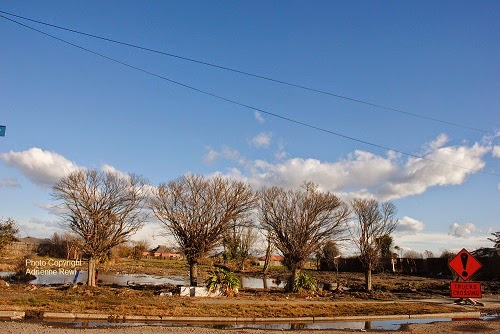
These streets in North New Brighton and Bexley show the grimness of the residential aftermath. Yet to be fully wiped clean of ruined houses, yet to be graded smooth and planted over with fresh grass seed, these red zones have a desolation and a loneliness that is difficult to describe. You can't capture the devastation fully on camera but you can certainly 'feel' it and see it, as you drive through.

My own home is currently being repaired by EQC and because of that I think, I have become a little blase, a little complacent. It's not that I've forgotten these ruined places or the former residents whose lives have been turned upside down; but with long-awaited house repairs comes a singular joy - a sense of disbelief actually, that you're finally on the road to recovery and with each fresh coat of paint, it's easy to be side-tracked from others' grim reality. 


Today these suburban places lifted me out of my complacency.
They slapped me in the face with the toughest of emotions - loss, grief, anger, abandonment, loneliness, despair - their vast tracts of mud, broken roads and skeletal trees all the sadder in midwinter.


There are new habitats here now.
The ducks, the bossy plovers and the proud pukeko - they all stride across the gouged-out roads with a new confidence, with a sense of territorial ownership that brings you up short. It's odd and unexpected and charming all at once.


In many places, the roads - if they can still be called that - are barely recognisable. They're deeply rutted, often flooded and a trap in waiting for the under-carriage of cars travelling too fast. Not that you see many of those in these areas now either. There may be an occasional sightseer, or perhaps a former resident returning to their old neighbourhood. 
It's hard to know what turmoil of emotions must be confronting them as they drive through these abandoned, creepy streets. With rotting rolls of carpet and abandoned furniture strewn along street edges,  and graffiti rampant, there's no longer a sense of residential safety here. It's ghostly almost, eerie.


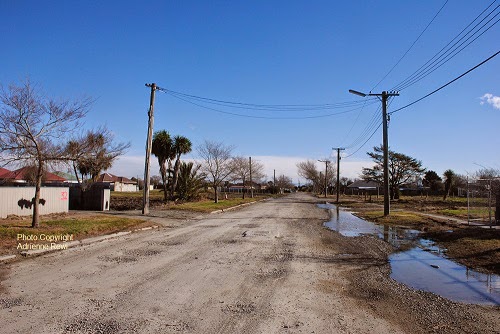
The ruin is heartbreaking, the sense of loneliness palpable.
The overgrown, fenced of children's playground, the single brown velvet chair at the end of a culdesac with its stuffing torn open - both metaphors for the rupture of suburban comforts.

Now permanently flooded roads - nothing really to do with rainfall; a few remaining boarded up windows, broken fences; sagging, disconnected, broken power lines; shattered glass and stolen supermarket trolleys stranded in mud and puddles, torn net curtains - almost more powerful and visually jarring now, almost four years after the first earthquakes, than they were in the beginning.

I sit here now, in the comfort of my temporary EQC accommodation in the heart of Merivale knowing that my own house further east is on the mend. I should be happy but I feel the deep and indescribable sadness - that sadness that descends so often and so unexpectedly on so many Christchurch people; and I realise at last, that it may never go away.

Monday, May 12, 2014

Four Houses, Four Families, Four Stories

I have hundreds of photographs of abandoned red zone houses in Christchurch.
I only have forty or so recorded stories from some of the earthquake-battered people who once lived in them - people who then, in the thick of thousands of after-shocks, were only too willing to talk about one of the most shattering and damaging experiences of their lives.
I often wonder now, as I walk or cycle through these sad, sad abandoned residential areas, what has become of all of the people - not only the ones I interviewed but all the others too. The thousands who have made off to other places.  I wonder what they have taken with them - what memories, what dreams and aspirations, what physical treasures that were too important to leave behind
With every passing week, more and more of these abandoned red-zoned homes are being demolished.
What were once busy suburban communities filled with spinning clothes lines, screaming kids, yelling parents, loud stereos and idling cars, have been reduced to flat, barren tracts of land scraped bare of their suburban histories. Every gone. The few saved trees and the freshly sown grass no replacement for family life.
It's a good thing that so many people have gathered these family stories.
Because before long, we will need to be reminded of them - reminded of the families who once made up the once-vibrant communities of east Christchurch; reminded of the merciless power of Nature to wreck and reshape the human spirit.

Friday, October 4, 2013

The Way Things Used to Be

Every so often, in an idle moment, I scan through my digital photo files peering at old photos of Christchurch.
Old being pre-September 2010, before the 7.1 earthquake struck that is.
I'm always amazed by how much I have already forgotten, just three years on.
I took these photographs inside Christchurch Cathedral in the Square.
And as we all know, the Cathedral now sits in ruins - towers broken, steeple gone, roof collapsing, mould growing over the stone exterior, pigeons pooping through the interior.
It's a pale, sad shadow of what it used to be, of what you see here.
I'm not a religious person but I am very fond of church architecture and I often went into this cathedral - and, to my mind, the even more spectacular Catholic Basilica -  just to sit and watch and listen and contemplate.
Some of my favourite views are those minus people, or, as in this case, just a hint, a shadow of others.
(I've noticed that most of my photographs are either of people, or places - seldom both in one shot).
The famous rose window.
In storage somewhere now  (I think).
And with the choristers practising for the annual Christmas performance.
This year I guess they'll give us a tune in Shigeru Ban's Cardboard Cathedral - a very nice temporary replacement.
Same view, different day, different year and fewer people.
And the exterior view that dons a thousand (at least) tourist books.
I used to take this view so much for granted.
I take very little for granted any more.

Sunday, August 11, 2013

A City's Scars

There's a haunted, almost ghostly feeling to parts of east Christchurch now.
Almost three years on from the first  7.1 magnitude earthquake of September 4, 2010, huge swathes of some eastern residential suburbs lie abandoned and desolate. Thousands of red-zoned homes sit in a state of abandoned squalor or, increasingly, they have vanished off the face of the earth, as demolition kicks into high gear.
I've walked these red-zoned suburbs constantly over the last three years, watching the downward progression of once-vibrant neighbourhoods. Yesterday, on a cold, grey, mid-winter day, it was an even more sobering experience than usual. The level of decay and ruin seemed heightened and my imagination found it more difficult to conjure up the memories of how things used to be. 
As hideous as the Christchurch earthquakes have been over the last three years, I've always had a willingness to capture the aftermath on film. I've felt a palpable sense of excitement at the strange and compelling sights in our broken city. The city's scars have stimulated my imagination and made me think in depth about memory, identity, loss and fear.
Yesterday, I just thought about loss and I wondered how some people will ever recover.
Our city is scarred.
Our people are scarred.
The residential earth is very definitely scarred - scraped clean, torn asunder, flooded, over-grown, unkempt.
In parts, there is little trace left of human habitation - a lone flowering camellia warming up to the idea of spring; a tenacious clump of snowdrops defying winter.
A lone specimen tree, the only survivor of demolition.
Christchurch has been in the news constantly for the last three years.
The rest of New Zealand has been bombarded with images and tales of destruction.
The inner city has been highlighted - the commercial  impacts emphasised.
But out in the ruined, red-zoned eastern suburbs, whole communities have battled with much more than broken architecture and invasive liquefaction. They've had to leave their homes - homes they've often lived in for decades. They've had to farewell their gardens, with whole chapters of their past relegated to memory. Then, as well as battling for compensation and negotiating the rebuilding of their lives, they have had to watch all physical evidence of those years be wiped off the face of the earth.
As much as we all hate the word resilience in Christchurch, it does capture something of the strength and determination needed to come back from all that.
Call me sentimental if you will but there's something heart-wrenching about wandering streets filled with scraped-bare sections, a solo tree trying to survive the rigours of demolition.
We all knew it was coming - that stripping of the residential land; but up until recently it was a house here, a house there - shocking but manageable. You could get your head around those small ruptures in the residential landscape. A few months on, it's a different story. Now there are huge tracts of land sitting vacant. Sometimes as many as eight or nine properties in a row, gone.
To say it is sobering is an under-statement.
I wonder what the previous owners think now when they drive by their empty sections - if, in fact they have the will to even do that. How do you look upon that land and not re-live the horrors of the actual earthquakes, hotly followed up by the horrors of disaster and recovery bureaucracy?
I am sure there are many who never go back.
I am sure there are many who are just pleased to have the whole business settled, regardless of the fact that they've lost so much.
When I see stubborn snowdrops and daffodils pushing through these scraped-bare gardens I am both dismayed and heartened at the same time. I feel an intense melancholy, a nostalgia for the recent past, for sunnier more stable times; but at the same time I feel a rush of pleasure that so many Cantabrians have, like the snowdrops and daffodils, pushed through the (bureaucratic) crap and come out the other side. It's depressing that many (including myself) have yet to even begin that battle with authorities and insurance companies; that three years on, some will probably *still* be waiting two years from now.
That should be a wake-up call for all of New Zealand because, as Marlborough and Wellington earthquakes have recently demonstrated, none of us can afford to ignore the ramifications of disaster.

Abandonment, ruin, decay and emptiness can all stimulate our imaginations and fire us up at a creative level but there is no escaping the fact that these residential voids - laden with loss - come at a huge human cost. That cost may not have been in lives lost - I don't think anyone died in the suburbs, in a residential setting during any of the Christchurch earthquakes - but who is to say the loss of a home is not just as traumatic?
To me these empty spaces represent a sad pause, a silent hiatus in the evolution of Christchurch social history - a hyphen if you will, that bridges the gap between before and after (the earthquakes).


My natural inclination is to fill the voids with memories.
I layer them with meaning and in the deep, all pervasive silence, I stand there and imagine I can hear laughter.
Sometimes, that feels like the only thing you can do.

Saturday, June 15, 2013

Once again from the top......

It's been a while since I wandered our broken city taking photographs - got bored with it.
As I've noted here on previous occasions, there comes a point when I need time out.

But here are a few shots I took a couple of weeks ago when I wandered along the most recently opened section of the Red Zone. As always, I was taken by the materiality of things - the improvised sheets of plywood set against plaster or bricks, the 'shadows' left by demolished buildings, the clusters of ugly heating vents, now exposed for all to see.

I like the brutality of those solid concrete walls that were once shut away down alleys, or blocked from view by other buildings.

There are new words to discover - old words that is, newly revealed.
And the starkness of solo high rise that seems to teeter at odd angles.

There's the endless disarray of demolition sites and the wonder at how rapidly a city can change its face
And there are the chairs.
I've always loved chairs but in the wake of the Christchurch earthquakes, I've come to love them all the more for the unpredictable ways they have presented themselves, all over the city - out of place, out of kilter.... much like many of the city's people really.

LinkWithin

Blog Widget by LinkWithin