Sunday, September 29, 2013

Art in Unexpected Places

One of my favourite shots of Michael Parakowhai's Bull - looking ready to charge the portaloos.

He makes a good billboard too, outside the still-closed Christchurch Art Gallery.

I walked around inner city Christchurch last weekend and found myself photographing some of the many art works that have sprung up since the 2010 earthquake They are many and diverse, and I've photographed a lot of them many times, at different times of day (and night), in different weather. I like that we can do this now - that we have this sudden intimacy with contemporary artworks away from the more formal confines of an art gallery. It brings them to life in new ways I think.
I haven't names all the works I've shown here - mostly because I've either forgotten who the artist is, or, more likely, it's Sunday and I can't be bothered digging around in my files to find out. But I have gathered these images for visual pleasure - and to remind people everywhere that not everything about earthquake-stricken Christchurch is grey and glum and broken.
This is a fabulous display of photographs and texts related to the Christchurch earthquakes - interviews with those who have lived through the worst of it. It stretches along Worcester Boulevard and if you're in Christchurch, it's definitely worth a long look.
I like that the ability to decorate our battered city isn't restricted to the art elite. There's a ton of street art showing up, illuminating dark corners, and this series of works outside the broken (and closed) Christchurch Arts Centre - by school kids I'd say.
Dick Frizzell's marvellous work, set off beautifully by towering cranes and the skeletal beginnings of a new rebuild.
And a wider view, showing my favourite yellow work on the rear of Christchurch Art Gallery - artist's name forgotten and I'm too lazy to get out of my chair to find the appropriate issue of the gallery mag. part of the gallery's Outer Spaces series anyway.
""Fly me up to where you are" by Tiffany Singh, suspended outside the Christchurch City Council - and nicely reflected in the glazed facade.
Another work - I think - from Christchurch Art Gallery's Outer Spaces series called 'Faces from the Collection." Artist unknown.
"Faux Arcadia" by Michaela Cox, high on an exposed concrete block wall at the intersection of High and Hereford Streets.
Street art, Restart Mall
The painted aerial pedestrian walkway over Colombo Street - or part of.

Another from "Faces in the Collection" - this one by Michael Smither.
I like the way it sits beside advertisements for hayfever and allergy medications on the outside of a Cashel Mall pharmacy.
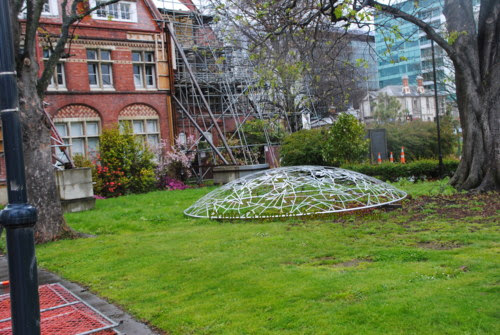
And perhaps my favourite shot of all - One of Neil Dawson's sculptures, sitting on a cordoned off patch of grass like a strange space ship clone. It used to hang over Cashel Mall before the earthquakes. Now it sits here under the trees, behind the cordoned off Otautahi building, waiting for a new beginning.
We all do a lot of waiting around here.
So it's nice to have interesting things to look at.
We could be waiting a lot longer yet.
For repairs.
For a new city.

Sunday, August 11, 2013

A City's Scars

There's a haunted, almost ghostly feeling to parts of east Christchurch now.
Almost three years on from the first  7.1 magnitude earthquake of September 4, 2010, huge swathes of some eastern residential suburbs lie abandoned and desolate. Thousands of red-zoned homes sit in a state of abandoned squalor or, increasingly, they have vanished off the face of the earth, as demolition kicks into high gear.
I've walked these red-zoned suburbs constantly over the last three years, watching the downward progression of once-vibrant neighbourhoods. Yesterday, on a cold, grey, mid-winter day, it was an even more sobering experience than usual. The level of decay and ruin seemed heightened and my imagination found it more difficult to conjure up the memories of how things used to be. 
As hideous as the Christchurch earthquakes have been over the last three years, I've always had a willingness to capture the aftermath on film. I've felt a palpable sense of excitement at the strange and compelling sights in our broken city. The city's scars have stimulated my imagination and made me think in depth about memory, identity, loss and fear.
Yesterday, I just thought about loss and I wondered how some people will ever recover.
Our city is scarred.
Our people are scarred.
The residential earth is very definitely scarred - scraped clean, torn asunder, flooded, over-grown, unkempt.
In parts, there is little trace left of human habitation - a lone flowering camellia warming up to the idea of spring; a tenacious clump of snowdrops defying winter.
A lone specimen tree, the only survivor of demolition.
Christchurch has been in the news constantly for the last three years.
The rest of New Zealand has been bombarded with images and tales of destruction.
The inner city has been highlighted - the commercial  impacts emphasised.
But out in the ruined, red-zoned eastern suburbs, whole communities have battled with much more than broken architecture and invasive liquefaction. They've had to leave their homes - homes they've often lived in for decades. They've had to farewell their gardens, with whole chapters of their past relegated to memory. Then, as well as battling for compensation and negotiating the rebuilding of their lives, they have had to watch all physical evidence of those years be wiped off the face of the earth.
As much as we all hate the word resilience in Christchurch, it does capture something of the strength and determination needed to come back from all that.
Call me sentimental if you will but there's something heart-wrenching about wandering streets filled with scraped-bare sections, a solo tree trying to survive the rigours of demolition.
We all knew it was coming - that stripping of the residential land; but up until recently it was a house here, a house there - shocking but manageable. You could get your head around those small ruptures in the residential landscape. A few months on, it's a different story. Now there are huge tracts of land sitting vacant. Sometimes as many as eight or nine properties in a row, gone.
To say it is sobering is an under-statement.
I wonder what the previous owners think now when they drive by their empty sections - if, in fact they have the will to even do that. How do you look upon that land and not re-live the horrors of the actual earthquakes, hotly followed up by the horrors of disaster and recovery bureaucracy?
I am sure there are many who never go back.
I am sure there are many who are just pleased to have the whole business settled, regardless of the fact that they've lost so much.
When I see stubborn snowdrops and daffodils pushing through these scraped-bare gardens I am both dismayed and heartened at the same time. I feel an intense melancholy, a nostalgia for the recent past, for sunnier more stable times; but at the same time I feel a rush of pleasure that so many Cantabrians have, like the snowdrops and daffodils, pushed through the (bureaucratic) crap and come out the other side. It's depressing that many (including myself) have yet to even begin that battle with authorities and insurance companies; that three years on, some will probably *still* be waiting two years from now.
That should be a wake-up call for all of New Zealand because, as Marlborough and Wellington earthquakes have recently demonstrated, none of us can afford to ignore the ramifications of disaster.

Abandonment, ruin, decay and emptiness can all stimulate our imaginations and fire us up at a creative level but there is no escaping the fact that these residential voids - laden with loss - come at a huge human cost. That cost may not have been in lives lost - I don't think anyone died in the suburbs, in a residential setting during any of the Christchurch earthquakes - but who is to say the loss of a home is not just as traumatic?
To me these empty spaces represent a sad pause, a silent hiatus in the evolution of Christchurch social history - a hyphen if you will, that bridges the gap between before and after (the earthquakes).


My natural inclination is to fill the voids with memories.
I layer them with meaning and in the deep, all pervasive silence, I stand there and imagine I can hear laughter.
Sometimes, that feels like the only thing you can do.

Sunday, June 23, 2013

A Week of Rain

We've had a week of rain, hail, sleet and snow in Christchurch and during that time, I've been more than a little transfixed by the effect its all had on the city. So today, my camera and I went to inspect - long after everyone else has already covered the worst of the elements but there was still plenty to see. In fact, it seemed to be the activity of the day. With a little sunshine, everyone was out walking, eyeing up the still swollen rivers and creeks.
Certainly the river that normally meanders at a gentle pace through Beckenham and Opawa (is it the Heathcote River perhaps?), was still a fast-flowing torrent lapping at the edges of gardens.
The paper-delivery girl stopped in her tracks.
The extensive surface flooding in South Hagley Park giving birth to a tangle of reflections
The black, bare branches looking slighting ominous and animate.
The South Hagley cricket pitch 'rained off.'
The riverside picnic tables stranded in the meddle of fast-flowing floodwater at Beckenham.
Roads closed all around Opawa.
Little Hagley Park in the north - the gaunt trunks of giant trees sleek and shiny with winter wet.

Opawa, where river and street merge
Making the most of extra water at Beckenham

And impossible for me not to refer the earthquakes at some level. Here, a reflective view of the ruins of the Catholic Basilica - always a sad sight.

"in a winter landscape - especially in a wood - there is the same kind of purity that the Greeks saw in the unclad human form..."

Saturday, June 15, 2013

Once again from the top......

It's been a while since I wandered our broken city taking photographs - got bored with it.
As I've noted here on previous occasions, there comes a point when I need time out.

But here are a few shots I took a couple of weeks ago when I wandered along the most recently opened section of the Red Zone. As always, I was taken by the materiality of things - the improvised sheets of plywood set against plaster or bricks, the 'shadows' left by demolished buildings, the clusters of ugly heating vents, now exposed for all to see.

I like the brutality of those solid concrete walls that were once shut away down alleys, or blocked from view by other buildings.

There are new words to discover - old words that is, newly revealed.
And the starkness of solo high rise that seems to teeter at odd angles.

There's the endless disarray of demolition sites and the wonder at how rapidly a city can change its face
And there are the chairs.
I've always loved chairs but in the wake of the Christchurch earthquakes, I've come to love them all the more for the unpredictable ways they have presented themselves, all over the city - out of place, out of kilter.... much like many of the city's people really.

LinkWithin

Blog Widget by LinkWithin