Showing posts with label public art. Show all posts

Wednesday, May 4, 2011

In the Loop

"Passing Time." It's not until I go into the city - or as close as one can get in these days of ruin and red zones - that I realise just how out-of-the-loop I have become. This not helped of course, by the fact that I'm closeted away writing another travel guide. I didn't even realise this new sculpture - "Passing Time" by Anton Parsons - had been installed in the Wilson's Reserve area of Christchurch Polytechnic Institute of Tecnology (CPIT). It was commissioned by the CPIT Foundation and the Christchurch City Council Public Art Advisory Group and was installed several weeks ago... or maybe even months ago? I like it. The numbers on the loop depict each year between 1906 (the founding of CPIT) and 2010.

Monday, December 13, 2010

Auckland Art - A Sculpture Trail

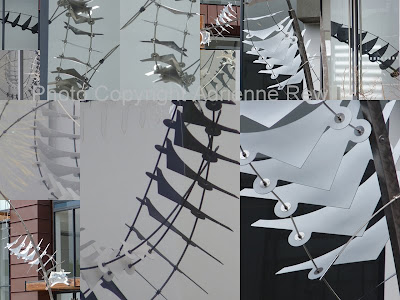
On a recent visit to Auckland, I was very taken with this sculpture suspended over the Engineering Department of Auckland University in Symonds Street. I searched inside and out and asked several people but I was unable to find out who the work has been created by. If any readers know, perhaps you'd like to leave a short comment about who the artist might be?
On a separate occasion, wandering in the grey drizzle of a winter afternoon, I came upon "Flight Trainer for Albatross" by Greer Twiss. The first work commissioned by the Auckland City Sculpture Trust, it's part of the Waterfront Sculpture Trail, which currently includes seven works. It's not a work that I'm personally drawn to - I much prefer Michael Parekowhai's Britomart work and Dennis O'Connor's "Raupo Rap" in Viaduct Harbour - but I certainly sympathise with the conservation message it adddresses. The work is a metaphor for the support we need to give endangered birds like the albatross. Every year untold numbers are killed or maimed through trawling and netting at sea and while not all are killed directly, thousands are maimed and unable to fly - which leads to their death by starvation.

Thursday, November 11, 2010

A Manawatu Sculpture Walk

I lived in and near Palmerston North in the Central North Island's Manawatu region in the late seventies but after I moved to the South Island in 1990, I've only ever been back there once. So when I rolled into town this year - in July - I was amazed by two very unexpected things - how much nostalgia I felt and that I actually got lost in now unfamiliar streets. I did however find what was the Manawatu Art Gallery in my day - now Te Manawa - Museum Gallery & Science Centre, which is currently undergoing a massive extension programme due for completion in late 2011. This is where I began a wander that tracked some of the city's public sculptures......the above unnamed, outside Te Manawa. Also outside Te Manawa, this - "Pacific Monarch" by Paul Dibble and commissioned by the Manawatu Art Gallery in 1992.
Further down the street, in the middle of a traffic island near the Palmerston North City Council building, I found this work - my favourite of the bunch - "The Returning Column" by South Australian sculptor, Greg Johns. Made of corten steel, the 5-metre high work, the work was acquired by the Palmerston North Public Sculpture Trust.
"United-Divided" by Christchurch sculptor, Phil Price is in the same vicinity and is the fourth work installed by the Palmerston North Sculpture Trust. It sits outside the Palmerston North Convention Centre and was unveiled in February 2010. Like its eerily similar Christchurch counterpart (in orange), the kinetic work rolls, dips, 'breaks apart' and rotates, "coming together and then dividing in a continuous, seemingly random, wind-driven performance." There's also a terrific work - "Numbers" by Anton Parsons and a beautiful wall work by Guy Ngan, neither of which I had time to photograph. All of the above, in addition to the striking collection of Maori sculptures in The Square, near the council buildings, are a very pleasing addition to the cityscape. While I found the remodelled square itself slightly 'communist' in feel, I always love it when a city installs contemporary public art for us all to muse over. It seems no two people can ever agree on their appropriateness, their beauty or their worth but that's half the fun of it. Good art should touch a few 'raw nerves.'

Tuesday, August 24, 2010

From the Collection

On a recent visit to Auckland, I had plenty of time to discover more of the sometimes hard-to-find public art that no body seems to promote in any real, cohesive way - say in a small booklet the way Wellington does - but every so often, I came upon things unexpectedly. The works shown here are not actually public works, they're from the Price Waterhouse Coopers Collection and are displayed in the $171,000,000, 33-storey tower block designed by Stephenson & Turner Architects at 188 Quay Street.
The building has the largest floor plates of any in New Zealand and was opened in 2002 by Prime Minister, Helen Clark. The blue work above is 'OKO' by Gregor Kregar, whose works, strangely, I kept encountering right throughout New Zealand on my recent road trip. The yellow sculpture is 'Yellow Construction 2002' (no surprises there), by Graham Snowden. The works was commissioned in fulfilment of the Works of Art Floor Area Bonus granted by Auckland City Council.
Revised Text: Thanks to a knowledgable reader, I can now expand upon the below uninformed waffle and state that the neon work above is by one of New Zealand's most celebrated artists, Bill Culbert (b.1935), who left New Zealand in 1957 to study at the Royal College of Art in London. Culbert, who lives in the South of France and London, returns to New Zealand regularly. Light has been a constant theme in his sculptural installations.
[This neon work however, remains a mystery. I'm thinking Paul Hartigan but perhaps I assume too much; he surely can't be the only artist using neon as a medium. Regardless, I like the way it circles whimsically through the solid entrance to the Price Waterhouse Coopers building. And naturally it looks much better at night when its form is more strongly outlined].

Wednesday, July 21, 2010

Walking Through

When I was in Wellington a few weeks ago, I sat outside Victoria University's Pipitea Campus, near Bunny Sreet and watched people coming and going, weaving their way through the four sculptures that make up "Seismic Shock," a work by Auckland sculptor, Louise Purvis, installed in 2006.
I'm always interested in the way people react to public sculptures, how they acknowledge them - or not - as they pass by; how they react to other people taking an interest in elements of what may be their everyday environment. I wonder how many people who pass these elegant Carrara marble spheres on a regular basis, have actually stopped and touched them and thought about their relevance. And why did my sitting on one of them raise eyebrows and get second, sometimes admonishing looks? I would have thought Purvis would be delighted that someone had taken the time to run a hand across their smooth, silky surfaces - surfaces that in fact represent topographic gridlines, earthquakes and their disruptive effects on the landscape. Scattered, as though flung about in an earthquake, these 3.5 tonne spheres give us the chance to contemplate the precariousness of life on a faultline. That's a little too sobering for some perhaps. www.sculpture.org.nz

Tuesday, June 29, 2010

Art in the Trees

Like a Mirage
Hoisted Above Trees
"Ripple"
By Neil Dawson
On the Riverbank outside Waikato Museum.
June 2010. Ajr

Wednesday, June 9, 2010

Making Way for Art

"Invisible Art"
Anton Parsons
Every time I discover another public sculpture in inner city Wellington, my heart gives an excited little leap. The Wellington Sculpture Trust, formed in 1982, has this fabulous idea that urban spaces can be enhanced by a widely diverse assortment of sculptures by New Zealand artists - it's an idea I wish more New Zealand cities would embrace more whole-heartedly. Christchurch is getting there but I always feel there's a decided lack of good public art in Auckland - an no, I'm not counting Waiheke Island or other private sculpture gardens. I'm sure many people and Wellington and Christchurch ignore the works that are springing up in their midst - walk by them everyday without considering their message, their beauty, their context -though frankly it's a little hard sometimes given the size and presence of most of them. The choices made are always interesting and usually not without their controversy (especially in Christchurch) but I always see large, contemporary public sculpture as a continuation of sorts, of a city's architecture - an important contribution to 'the scale of things,' a statement about who we are as New Zealanders and the issues that inspire us to creativity. Sculpture should be as much a part of the fabric of any city as the people themselves in my view.

Friday, March 12, 2010

A Girl on a Purse - Melbourne

In the short time I spent at Melbourne's GPO building on the corner of Elizabeth and Swanston Streets the other day, I photographed four different people getting their photos taken on this quirky marble purse sculpture that sits out in the GPO forecourt. It seems to appeal to people of all ages.

Thursday, March 11, 2010

Art on a Corner

I liked this kind of whacky sculpture by Chris Reynolds “A History of Apparatus” (Vessel, Craft and Beacon), which graces the corner of Russell and Bourke Streets in central Melbourne.
It makes me think of science fiction movies. It was a gift to the city in 1995. The third shot down shows detail photographed on the side of the main body of the sculpture.

Thursday, December 10, 2009

Up With the Birds

I was out photographing yesterday and just happened to arrive at City Mall at precisely the right moment as Christchurch sculptor, Neil Dawson and a team of orange-jacketed, hard-hatted workers were raising Neil's latest public sculpture, Sky Lens above the mall.
Cranes and sculpture coming together in one happy event and intricate patterns etched against the grey, broody sky - I couldn't have been happier.
That's Neil (above) taking time out for a quick chat.
The $140,000 laser-cut, aluminium work measures six metres across and weighs in at 160kg. Unfortunately for Neil and his installation team, the notorious Canterbury nor'west wind was gusting through the mall but they took the conditions in their stride and everything appeared to go to plan.
The sculpture features 'a series of interlocking paper darts' and has evolved out of a series of small domed wall works that Dawson exhibited around five years ago. "It usually takes about five years for the interior works to make it outside," he says, pausing to shout instructions to the crane driver. Despite an outwardly calm facade and regular chats with passersby, Neil says the installation of his giant works is by far the most stressful part of the process. This in fact, was the second attempt to get the work installed above the revamped City Mall.
I sat and watched proceedings for quite some time and was greatly amused by the conversations going on around me. A surprising number of people seemed to think it was a giant Christmas decoration being put in place for the festive season. When I mentioned that to Neil he just sighed. "Oh we've had it all," he laughed. "The guy from a nearby Chinese takeaway place came out and said he was going to call it The Leaky Wok; and someone else told me it looked like a giant IUD." For my part, I think it's great and I look forward to seeing it at night with the coloured spotlights illuminating the intricate matrix of shapes. I think it's a perfect companion for Neil's Chalice, just a street away in Cathedral Square. If you click on Neil's name in the label line below, you'll see other Dawson sculptures around New Zealand that I've written about previously.

Wednesday, October 28, 2009

Early One Morning.....

......well...Saturday morning actually....as the sun was caught glinting on Graham Bennett's "Reasons for Voyaging" outside Christchurch Art Gallery just after a jet had flown by. I liked the soft fluff of the jetstream against the sharp steel of the sculpture. www.bennettsculpture.biz www.christchurchartgallery.org.nz

Saturday, October 17, 2009

Art Layers

Love the way someone has decided that Phil Price's sculpture at the intersection of High, Manchester and Lichfield Streets isn't enough in its own right. They've (somehow) scaled one face of it and added a whole heap of ghastly little stickers to it. It will be interesting to see how long they stay there before someone decides they need to be removed.

Tuesday, October 13, 2009

Responding to Nature

This is one of the few Christchurch public artworks that, up until now, I have studiously ignored. I’m not sure why. It’s not that I don’t like it – well, not exactly – rather that it annoys me at some level that I haven't quite been able to pinpoint. I feel a little cheated that Christchurch has ended up with what I would call one of Chris Booth’s ‘lesser works.’ The work, obviously created by New Zealand sculptor, Chris Booth, is entitled Taurapa and was created as the Christchurch-Seattle Sister City Sculpture in 1996-97. The form of the sculpture resembles a taurapa, or the stern post of a Maori waka (canoe) and it references the waka that once plied the river it sits beside. Booth, born in 1948 in the Far North, has exhibited widely throughout New Zealand and internationally. Along with several public works in New Zealand he has completed public commissions in Australia, the United Kingdom, Germany and the Netherlands. I’ve seen a good many of Booth’s works and he has a reverence for nature that I like – that in fact is what strikes a chord in most of his viewers. His works have a certain ‘humanity’ to them. He’s not trying to be too clever, too esoteric, too intellectual. They pay homage to the land they are created in; they use the materials of the site and they celebrate the raw beauty of nature. I particularly like his Earth Blanket series, which you can check out by visiting his website. (This work is from his Slab Series). Most of his major works are illustrated there, so I’ll let you form your own opinions. www.crhisbooth.co.nz

Monday, October 12, 2009

Lattitudes

Christchurch-based sculptor Graham Bennett recently presented a new exhibition called Latitudes at The Arthouse, here in Christchurch (Sept 16 – October 4). The show is theoretically over but when I drove past the gallery last weekend, his works were still in situ, still glinting in the sun, still casting small and miraculous shadows across the inside and outside of the building. I HAD to stop and take some long distance photos – little fragments of detail, slithers of shadow and reflection, a tangle of components and ideas. I’ve written about Bennett’s work on this blog before and he also features in my Artist Studio Series, which you can see by clicking on either name in the label line below. It’s been a busy year for Bennett. In 2008-2009 he’s had solo shows in Japan, Hong Kong, and Waiheke Island; and he’s created stunning collaborative works with Dunedin fashion designer, Donna Tulloch, which were shown at Dunedin’s ID Fashion Week and also later exhibited in Japan to coincide with Yokohama’s Triennale of Contemporary Art. (I’ve also featured these stunning smaller pieces on this blog – “When Sculpture Meets Fashion”). The year has also seen Bennett show large works at Waiheke Island’s terrific ‘headland – Sculpture on the Gulf’ and in Sculpture in Central Otago, another large outdoor exhibition staged at Rippon Vineyard in Wanaka. In addition to the interior works at The Arthouse’s new show, Bennett also created a new work – Orbit – which, at eight metres high, has been installed outside the gallery. You can find out more about Graham by checking his website: www.bennettsculpture.info www.thearthouse.co.nz

Thursday, August 20, 2009

A White Albatross

Wellington. April 2009 Ajr I’ve never been a real fan of Tanya Ashken’s sculpture ‘Albatross,’ which sits down on the Wellington waterfront. For a start, it always looks dirty and slightly slimy and stained. But I’m sure there are people who love it. It was installed as part of the Wellington Sculpture Trust project in 1985-86 – in fact fundraising for this ferro-cement work was what spurred the formation of the trust. It’s one of three of Ashken’s works around the capital and to be frank, I don’t like any of them. Ashken was born in England and actually trained as a silversmith. She married New Zealand artist, John Drawbridge in 1960 and after a stint in Paris (where she studied sculpture) they returned to New Zealand in 1963.

Wednesday, July 22, 2009

Back at the Chalice

Cathedral Square, Christchurch. July 2009. Ajr
You only need to click on the word Chalice in the label line below this post to see that I am totally seduced by the silvery-blue tangle of pattern that is Neil Dawson's Chalice, which dominates Cathedral Square. I rarely walk passed it without taking a photograph, so I have it summer, winter, spring, autumn, night, day, rain and sunshine. People seem to either love it or hate it. Obviously I love it as a photographic subject - and for the way it stands apart from the surrounding architecture; the way it dwarfs the busy throngs of photographing tourists at its base; the way it catches and reflects the light; the way it glows in the dark; the way it stirs controversy. Isn't that what a good piece of public art is supposed to do? As far as large, egotistic art statements go, I think its a beauty.

LinkWithin

Blog Widget by LinkWithin