Monday, April 12, 2010

Outer Spaces

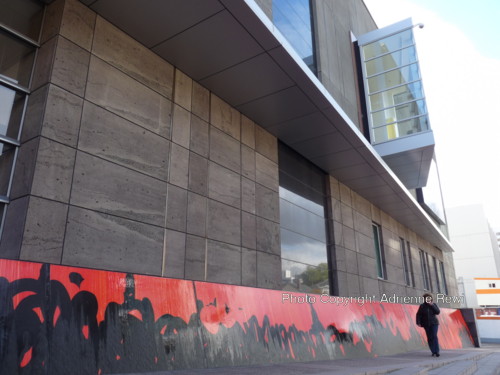
One of the latest work's in Christchurch Art Gallery's 'Outer Spaces' series, is the very appropriately-named 'Things To Do With Paint That Won't Dry' - a laminate and digital print on vinyl adhesive that artist, Andre Hemer has applied to the gallery's waterfall. I like it. The bands of coloured paint that appear to flow over the edge of the water feature remind me of graffiti and I fear that, once removed, their absence will only draw attention to just how unerringly dull and grey that side of the building is. It's just another of the Outer Spaces series that I think, should be permanent fixtures. www.christchurartgallery.org.nz

Sunday, April 11, 2010

In Pleasant Valley

It was all mood and mist in Pleasant Valley, South Canterbury the day I was introduced to the very delightful St. Anne's Church, a tiny architectural joy, tucked into the rural landscape, away from the road, behind a stand of old yew and poplar trees.
There, in the middle of fields and byways, a sign on the side of the road, 'advertising' the Family Eucharist service the next day. It was too good to pass up - the chance to wander into the silent church yard (before the Sunday service), to think about the building, the misty graveyard and all who had come and gone since the church was built in 1863.
St Anne's in fact, is the oldest church still in use in South Canterbury. Built of native timbers - matai, kahikatea and totara, felled in the bush directly behind the church - it stands as a reminder of industrious pioneer times. If you peer through the window (and sadly that's all we could do because the door was locked), you can still see the marks of the pit-saws and adzes, used to construct the interior rafters and the pews.
I loved its moody little cemetery enshrouded in mist; its cute arched windows; the white iron sign hanging against the yew tree; and the handwritten sign on the gate, reminding the locals of services held "every 4th Sunday." All a lovely legacy from the original settlers of the district, who built the church with volunteer labour.

Friday, April 9, 2010

Thursday, April 8, 2010

Cloud Piercer

The Hermitage Mt Cook. It's hard not to sound like a cliche when you talk about the big, dramatic landscapes of the south of the South Island. To say they are awe-inspiring (and they are) is a sorry understatement that really doesn't do the place justice and photographs like these don't capture the scale and majesty of the mountains, the sheer brute strength of the land.
I took the road into Mount Cook Village on my recent trip south. The weather held but Aoraki/ Mt Cook was playing the elusive seductress, tucked under a bundle of fluffy, sun-shot cloud -not shown in any of these images I should point out. (I couldn't see the point of adding a photograph with a caption pointing to an invisible mountain). I was on a travel guide mission - getting the grand tour of The Hermitage Hotel, the primary accommodation provider in the village, who also own the Hermitage Motels and Chalets.
I also took the opportunity to check out the new Sir Edmund Hillary Alpine Centre, which is located within The Hermitage. It showcases both the Mount Cook area and the life and work of Sir Edmund Hillary. I watched the documentary film of Sir Ed's work in the Himalayas and found it a particularly moving experience. In fact, I felt a little 'displaced' when I stepped back out into the landscape. I kept thinking I was in the Himalayas instead of the Southern Alps and drove off half expecting to be met by a herd of yak. The perils of a travel guide writer's over-active imagination!!!.

Wednesday, April 7, 2010

Sara Hughes - For Kultur

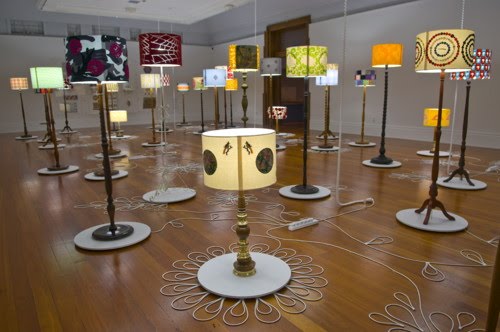
Both images: For Kultur - Sara Hughes, 2010, Hawke's Bay Museum & Art Gallery, Photography David Frost The last time I featured work by Auckland artist Sara Hughes, was when she embellished Christchurch Art Gallery with her sensational coloured stripes....and you can see that work by clicking on Sara's name in the label line below this post. If nothing else, it will give you an excellent counterpoint to her current show at Hawke's Bay Museum & Art Gallery - a warm, enticing show that is proving to be a winner with visitors to the gallery.
Three images above: For Kultur - Sara Hughes, 2010, Hawke's Bay Museum & Art Gallery, Photography David Frost For Kultur is colourful installation and Hughes's first exhibition in New Zealand since returning from her pretigious art residency in Berlin. The work is Hughes's unexpected response to the wealth of objects held by the Hawke's Bay Cultural Trust and it brings a fresh perspective to the positions museums play in preserving the stories of our communities, histories and cultures.
Bottom image above: For Kultur - Sara Hughes (Detail), 2010, Hawke's Bay Museum & Art Gallery, Photography David Frost.
Top image above: For Kultur - Sara Hughes, 2010, Hawke's Bay Cultural trust/Ruawharo Ta-u-Rangi, Pincushion, R165/18d, Photography David Frost. With over 100,000 individual items collected over 150 years, the Hawke's Bay Cultural Trust's collections offered the ideal place for Hughes to explore these ideas. Over the past six months she has been working closely with the the Hawke's Bay Museum & Art Gallery team, discovering and uncovering different items within the collection. This research sparked an interest in how diverse objects can come together to create new meanings.
Applying these ideas to her practice as a visual artist, Hughes embarked on creating a collection of her own, exploring the different voices and associations that develop between her new objects and those held by the collections of the Hawke's Bay Cultural Trust.
The end result is a charming assembly of familiar objects that (literally) throw new light onto the subject of collecting. Unlike many installation shows that often strike terror into the hearts of the 'artistically uninitiated', For Kultur, is an inviting display that is drawing in enthusiastic audiences. It is the final major exhibition at Hawke's Bay Museum & Art Gallery in the lead-up to the gallery's closure for re-development during 2010. A separate artwork by Hughes will become a significant feature of the new Hawke's Bay Museum & Art Gallery wing when it re-opens. For Kultur runs until June 27. All images supplied by Hawke's Bay Museum & Art Gallery. www.hbmag.co.nz

Tuesday, April 6, 2010

Back in the Country

Yesterday, I prattled on about life in rural New Zealand and the inherent values of that (see below posts) as perceived during my recent stay in small-town Woodbury in South Canterbury. Now I'm back to sing the praises of the adorably quaint Woodbury Library, a small dot of a building that hangs out below a stone wall on a quiet crossroads in the centre of the village.
When it's open, a little red flag goes up on the outdoor noticeboard and the door is left open, the building unattended, so locals can come and go as they please, browsing the history room (shown above), or selecting a book from the library shelves (below images).
It's all about that rural honesty thing again. The locals (there are 200 households in Woodbury) who care, know the library open hours, they go along, select their books, write them on their personal page of the 'Books Out' list and off they go again. The whole place delighted me. It reminded me of an old school room and I'm still amazed that someone has gone to so much trouble to create the town's history (with words and photographs, above) on one of the walls of the history room. Turns out there's a roster for tidying shelves, sorting and filing the boxes of donated books and making sure everything is shipshape - in the indomitable, organised, country way. Love it, love it, LOVE IT!

Monday, April 5, 2010

A Country Church

There's a simplicity to life in much of rural New Zealand that appeals to me. I was brought up in the country (in rural Waikato) and while that appalled me as a child and then as a teenager, eager to experience faster, more exciting things, I now see the value in 'a quiet life.'
I had that reinforced for me a week or so ago, when I stayed with friends in the small South Canterbury town of Woodbury. They've carved out a very pleasing lifestyle for themselves - and, thanks to modern technology, they're really no further from 'the fast lane' (work-wise) than they ever were; yet they're able to tune out of the rat-race and into their small community, where pressures seem minimal and friendships fast.
All that, by way of a lateral introduction to St Stephen's Anglican Church in Peel Forest. My friend, Jane had taken me on tiki-tour of the area and, ever the church architecture fan, we stopped at the almost 'microscopic' settlement of Peel Forest to poke our noses into pretty little St Stephens - and yes, thanks to the trusting country locals, this is one little church that leaves its front door unlocked. As it turned out, we'd just missed the Palm Sunday service (advertised on a crudely written sign to encourage the locals along) and the pig ferns used to represent palm leaves, were still huddled in a corner of the church (above). Like a number of the churches in this area, St Stephen's is an all-timber gem, a place that reeks of history and exudes a serene kind of atmosphere that always sets me to thinking of things spiritual and meaningful - but not necessarily religious.
There's an honesty to these little churches that appeals to me - both architecturally and metaphorically. They somehow sum up a way of life that is all-but gone, that lingers on in tiny settlements, generally perpetuated by the older community members. Maybe I'm stirred by a sense of nostalgia - nostalgia for younger, simpler years when a small-town church was part of my family life. You rarely appreciate these things in childhood. It's only when you're older and have come to see the value of community and honesty; and the beauty of the small things in life, the satisfying daily rituals that perpetuate human history, that you think of worth, simplicity and meaning in a community.
We didn't stay long in the church, there was no need. But there was time enough to admire the stacks of red bibles on the entry shelf, the minister's robes hanging in a curtained alcove, the small-but-perfect religious icons, the stained glass windows, the woodwork and the handsome beams. I wandered off, wondering what thoughts the local people attending the morning's Palm Sunday service might have taken away with them - and whether or not they would be back the following Sunday to sit again in this peaceful, thought-provoking haven on the edge of the forest.

Sunday, April 4, 2010

Re-Visiting the Light

Our old friend the David Trubridge light Coral/Floral is back
In Another Guise.
Click on David Trubridge in the label line below to see some of the other settings I've photographed this popular light design in.

Saturday, April 3, 2010

Through the Cafe Window

One of my favourite activities in Melbourne - or anywhere for that matter - is cruising the city streets with my camera, always alert for a potential photograph, stopping here and there at a cafe to watch the 'world' go by. Cafe windows in fact are a favourite sport.
For me, there's something about the layering of reflections, graphics and human activity that serves as a metaphor for city life - that busy over-layering that somehow sums up how we fill our days with multiple activities.
Cafes and restaurants say a lot more about a city than we think. Certainly, in Melbourne, there's no shortage of either and they are in fact, central to the social fabric of the city. They're a statement about the people and the multi-cultural maze that makes up the population; they're a statement about preferred lifestyle; and they're a statement about architecture and design. And it's no coincidence that this small photographic representation features all Italian names - Italian cafes and restaurants reflect the large Italian population that calls Melbourne home.

Cool Cars - 74

One Baby Pink Ford Thunderbird - Spotted at Oxford, North Canterbury.

Friday, April 2, 2010

Easter Egg Hatches

Assuming that today's Willowbank press release wasn't a huge April Fool's Day prank like the floating hotel in yesterday's post (below), Willowbank Wildlife Reserve has welcomed the hatching of ts 89th kiwi chick this season, at the New Zealand Conservation Trust's facility at the reserve.
Images supplied by Willowbank Wildlife Reserve, Christchurch.
Temporarily christianed 'Hot Cross,' the baby kiwi has since been named Nikau. The cute fluffy ball is a Great Spotted Kiwi, which originated from Paparoa and has been incubating at the New Zealand Conservation Trust's breeding facility for the last two months. Nikau is the Maori name for a native New Zealand palm tree, which ties in nicely with Easter and Palm Sunday. All chicks hatched at the breeding facility are released back into the wild at Okarito, Haast, Paparoa, Hawdon and Nelson lakes regions in the South Island when they reach1.2 kilograms in weight. The Great Spotted Kiwi species is believed to number in the region of 14-15,000 but it is declining at a rate of 2% (presumably per annum). www.willowbank.co.nz

Thursday, April 1, 2010

New Floating Hotel Planned

Pictured supplied by Christchurch Canterbury Tourism
Christchurch-based Black Cat Cruises have just announced plans for a NZ$40 development - a 100-room floating hotel and an 18-hole golf course - to be built in Lyttelton Harbour on and near Quail Island. Planned to be complete in time for next year's Rugby World Cup, the floating hotel will be a first for New Zealand and access to it will be via Black Cat Cruises, who run the Diamond Harbour Ferry, Lyttelton and Akaroa Harbour Cruises and dolphin swim operations. The golf course on Quail Island is 15 minutes by ferry from Lyttelton and will include an underground clubhouse, in line with what Black Cat representatives see as their environmental responsibilities. The hotel is being built in Bluff and will be towed up the Southern coastline and into Lyttelton Harbour once it is completed. www.blackcat.co.nz

StreetscapeNZ - 74

Main Street, Heathcote
Christchurch
November 2009. Ajr

Wednesday, March 31, 2010

It's All in the Feet.

Excuse me for seeming a little preoccupied with feet. I don't have a foot fetish - nothing even slightly resembling one; but I do believe an artist's skill can be measured somewhat by their ability to execute human feet and hands, whether that be in painting or sculpture. Thus it was, that I found myself intrigued by the feet of the Ron Mueck sculptures at the National Gallery of Victoria in Melbourne. So lifelike as to be surreal. Ranging from the 'tiny' toes of a (giant) newborn baby to the hairy toes of 'Wild Man' and the mesmerising feet of "Dead Dad," each pair of feet seemed more expressive than the last. London-based, Melbourne-born Mueck is internationally known for the astonishing realism of his sculptures - all of which capture something of the timeless human condition. His show continues at NGV until April 18th and then moves to Queensland Art Gallery (may 8 - August 8), before crossing the Tasman to open at its only New Zealand venue, Christchurch Art Gallery (Sept 30 - January 23, 2011).
Tuesday, March 30, 2010

Head in the Clouds

From Thursday to Sunday last week, I was working down south - at both Lake Ohau, south-west of Twizel, and in South Canterbury. I had spectacular weather for the first two days and spectacular clouds patterns to go with it. The Mackenzie Country and Central Otago are all about big mountains, big landscapes and big skies. I love the area for that and no matter what time of year you visit, no matter what the weather conditions, you can be assured of some dramatic visual effects crafted by the atmospheric gods. These four images are but a tiny sample.

LinkWithin

Blog Widget by LinkWithin